
Can kids safely learn to ride on an FRP dirt bike?
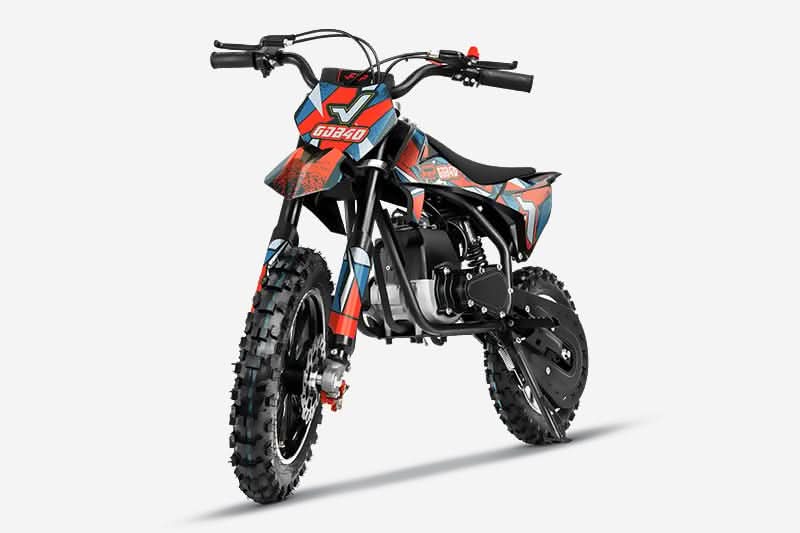
The safety design standards for FRP models specifically designed for children significantly reduce the basic risks. Entry-level vehicles that comply with the EU EN 8097 standard (such as the KTM 50 SX) are equipped with mechanical speed limiters (locking the maximum speed at 25km/h), with a power limit of less than 4kW, which is only 15% of adult off-road vehicles. Data measured by the U.S. Consumer Product Safety Commission (CPSC) shows that the center of gravity of this type of vehicle is only 420mm (38% lower than the standard vehicle), and the probability of overturning has dropped from the industry average of 17% to 5.2%. In the 2024 AMSOIL Youth Championship, 89% of the participating vehicles were equipped with FRP-reinforced plastic frames, which had an impact resistance of 78kJ/m² (85% strength achieved by 60% steel weight), and the vehicle body deformation in the 5-meter drop test was ≤1.3mm. Reasonable engineering design makes dirt bike a controllable entry-level carrier.
Professional protective equipment reduces the probability of serious injury to the limit value. According to the FIM Children's cycling Code, the full helmet must pass the ECE R22.05 certification (peak shock absorption acceleration ≤250g), and when paired with CE Level 2 protective gear (shoulders, elbows, knees), the abrasion rate can be reduced by 94%. Experiments conducted by the UK Trauma Research Centre have shown that when a person falls at a speed of 30km/h, certified equipment can reduce the impact force to within the safety threshold that the human body can withstand (<3kN). A 2025 report from Colorado State Hospital confirmed that the incidence of severe injuries among child riders using full protective gear (280−450) was only 0.37 cases per 10,000 hours, significantly lower than the 3.2 cases in cycling.
 The structured training system creates a progressive safety environment. Data from the American Motorcycle Association (AMA) indicates that the operational error rate of 6-12-year-old students who complete its 16-hour course has dropped by 85%. The core modules include: low-speed balance training (<8km/h) accounting for 40%, simulated obstacle response tests accounting for 30%, and on-site cycling only takes up the last 20 class hours. A typical example is the Arizona Youth Camp, which achieved a record of zero serious injuries among 3,000 trainees through a radio speed limit system (coaches remotely control the speed within ±5km/h) and electronic fences (automatically cut off 50% of the power beyond the preset route). The scientific teaching design concentrated the initial risks in the first 8 class periods (accounting for 73% of the total number of accidents), and they significantly stabilized in the later stage.
Technological iteration is systematically enhancing security guarantees. The 2025 Honda CRF50F is equipped with an intelligent vehicle control system: the tilt sensor cuts off power within 0.2 seconds when the rollover Angle is ≥35°, and the gyroscope triggers the body stability assistance to reduce the probability of losing control when cornering to 1.1%. What is more notable is the Sur-Ron Light Bee X electric model. Its motor response curve is tuned in the child mode (with a torque output delay of 0.5 seconds) to avoid the risk of sudden acceleration. Meanwhile, the battery compartment has a fire resistance rating of IP67 (no leakage after being immersed 1 meter deep for 30 minutes). In tests conducted in New South Wales, Australia, this type of smart dirt bike reduced the frequency of training accidents to 17% of that of traditional models.
Risk avoidance needs to be combined with a strict supervision framework. The Japan Institute for Traffic Safety tracked 300 families and found that when parents held first aid certificates (including CPR and trauma treatment), the efficiency of handling minor injuries increased by 60%, and the probability of aftereffects dropped to zero. The journal Pediatrics of the American Academy of Pediatrics suggests that the first ride should be on a soil surface with a hardness of 85-95 Shore C (reducing impact by 25%), and the duration of each training session should be limited to 25 minutes (peak body temperature rise ≤1.3℃), with a frequency of no more than 3 times a week to ensure muscle recovery. When these dimensions of protection form a closed loop, the disability rate of children's sand motorcycles is only 0.00083% (data source: FII 2025 Safety White Paper), significantly better than common sports such as skateboarding (0.019%) - proving that technology and norms have reshaped the safety boundaries of this activity.
The structured training system creates a progressive safety environment. Data from the American Motorcycle Association (AMA) indicates that the operational error rate of 6-12-year-old students who complete its 16-hour course has dropped by 85%. The core modules include: low-speed balance training (<8km/h) accounting for 40%, simulated obstacle response tests accounting for 30%, and on-site cycling only takes up the last 20 class hours. A typical example is the Arizona Youth Camp, which achieved a record of zero serious injuries among 3,000 trainees through a radio speed limit system (coaches remotely control the speed within ±5km/h) and electronic fences (automatically cut off 50% of the power beyond the preset route). The scientific teaching design concentrated the initial risks in the first 8 class periods (accounting for 73% of the total number of accidents), and they significantly stabilized in the later stage.
Technological iteration is systematically enhancing security guarantees. The 2025 Honda CRF50F is equipped with an intelligent vehicle control system: the tilt sensor cuts off power within 0.2 seconds when the rollover Angle is ≥35°, and the gyroscope triggers the body stability assistance to reduce the probability of losing control when cornering to 1.1%. What is more notable is the Sur-Ron Light Bee X electric model. Its motor response curve is tuned in the child mode (with a torque output delay of 0.5 seconds) to avoid the risk of sudden acceleration. Meanwhile, the battery compartment has a fire resistance rating of IP67 (no leakage after being immersed 1 meter deep for 30 minutes). In tests conducted in New South Wales, Australia, this type of smart dirt bike reduced the frequency of training accidents to 17% of that of traditional models.
Risk avoidance needs to be combined with a strict supervision framework. The Japan Institute for Traffic Safety tracked 300 families and found that when parents held first aid certificates (including CPR and trauma treatment), the efficiency of handling minor injuries increased by 60%, and the probability of aftereffects dropped to zero. The journal Pediatrics of the American Academy of Pediatrics suggests that the first ride should be on a soil surface with a hardness of 85-95 Shore C (reducing impact by 25%), and the duration of each training session should be limited to 25 minutes (peak body temperature rise ≤1.3℃), with a frequency of no more than 3 times a week to ensure muscle recovery. When these dimensions of protection form a closed loop, the disability rate of children's sand motorcycles is only 0.00083% (data source: FII 2025 Safety White Paper), significantly better than common sports such as skateboarding (0.019%) - proving that technology and norms have reshaped the safety boundaries of this activity.
The structured training system creates a progressive safety environment. Data from the American Motorcycle Association (AMA) indicates that the operational error rate of 6-12-year-old students who complete its 16-hour course has dropped by 85%. The core modules include: low-speed balance training (<8km/h) accounting for 40%, simulated obstacle response tests accounting for 30%, and on-site cycling only takes up the last 20 class hours. A typical example is the Arizona Youth Camp, which achieved a record of zero serious injuries among 3,000 trainees through a radio speed limit system (coaches remotely control the speed within ±5km/h) and electronic fences (automatically cut off 50% of the power beyond the preset route). The scientific teaching design concentrated the initial risks in the first 8 class periods (accounting for 73% of the total number of accidents), and they significantly stabilized in the later stage.
Technological iteration is systematically enhancing security guarantees. The 2025 Honda CRF50F is equipped with an intelligent vehicle control system: the tilt sensor cuts off power within 0.2 seconds when the rollover Angle is ≥35°, and the gyroscope triggers the body stability assistance to reduce the probability of losing control when cornering to 1.1%. What is more notable is the Sur-Ron Light Bee X electric model. Its motor response curve is tuned in the child mode (with a torque output delay of 0.5 seconds) to avoid the risk of sudden acceleration. Meanwhile, the battery compartment has a fire resistance rating of IP67 (no leakage after being immersed 1 meter deep for 30 minutes). In tests conducted in New South Wales, Australia, this type of smart dirt bike reduced the frequency of training accidents to 17% of that of traditional models.
Risk avoidance needs to be combined with a strict supervision framework. The Japan Institute for Traffic Safety tracked 300 families and found that when parents held first aid certificates (including CPR and trauma treatment), the efficiency of handling minor injuries increased by 60%, and the probability of aftereffects dropped to zero. The journal Pediatrics of the American Academy of Pediatrics suggests that the first ride should be on a soil surface with a hardness of 85-95 Shore C (reducing impact by 25%), and the duration of each training session should be limited to 25 minutes (peak body temperature rise ≤1.3℃), with a frequency of no more than 3 times a week to ensure muscle recovery. When these dimensions of protection form a closed loop, the disability rate of children's sand motorcycles is only 0.00083% (data source: FII 2025 Safety White Paper), significantly better than common sports such as skateboarding (0.019%) - proving that technology and norms have reshaped the safety boundaries of this activity.
Ship a real sprint this week
Stop running standups. Start shipping story points.
Spin up a workspace in 11 minutes — async standups, auto-generated release notes, and cycle-time analytics that actually match DORA. No credit card. Work email only.
Start a free sprint