
How to Read Fragrance Manufacturing Case Studies as a Cost Breakdown
A published project example is a portfolio entry, not a price list. It tells you what a manufacturer is capable of building — category, pack format, decoration level, number of variants — and it deliberately leaves out the numbers that decide your unit cost. That is not dishonesty; unit cost depends on volume, fill weight and tooling that differ for every buyer. The skill is reading the visible details as cost signals, then asking the manufacturer to fill in the missing lines.
Key takeaways
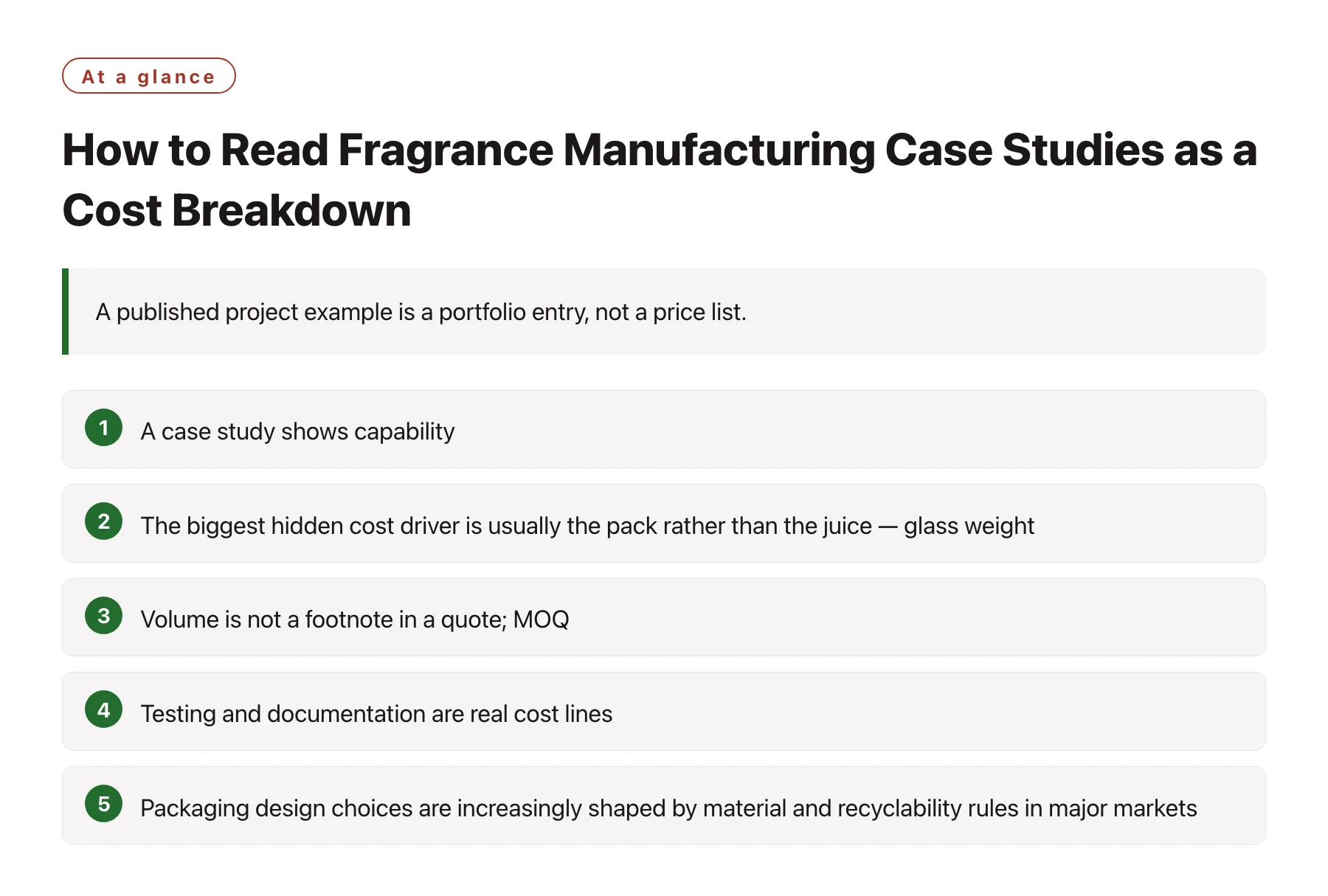
- A case study shows capability, not price: the useful signals are pack format, decoration method, variant count and category, because each one maps to a cost line.
- The biggest hidden cost driver is usually the pack rather than the juice — glass weight, decoration, closures and secondary packaging often move the unit cost more than the fragrance itself.
- Volume is not a footnote in a quote; MOQ, tooling amortisation and component sourcing terms change unit cost more than most buyers expect.
- Testing and documentation are real cost lines, not overhead, and the scope of testing follows the destination market rather than the factory [1].
- Packaging design choices are increasingly shaped by material and recyclability rules in major markets, which feeds directly into component cost and lead time [2].
Buyers usually arrive at a set of project examples looking for a reference price. What they find instead is a set of design decisions, and those decisions are often more informative than a number would be, because they show where a manufacturer spends effort and where it economises.
This is a method for extracting a cost model from that material, so that the first real quote you receive can be judged against something rather than accepted on trust.
Read the example as a set of decisions
Every project shown on a manufacturer's portfolio page encodes a series of choices: what category the product sits in, how the bottle is formed, how it is decorated, how many variants were produced, and how the whole thing is presented on shelf. Each choice has a cost consequence that is stable enough to reason about, even without knowing the price.
This is where a page of custom fragrance case studies earns its place in a buying process. It is not evidence that your product will cost a particular amount; it is evidence that the manufacturer has handled a particular combination of pack, decoration and category before, which reduces the number of unknowns in your own project.
Decoration is the quiet cost multiplier
A clear bottle with a simple label and a lacquered bottle with hot-stamped metal are not the same product at different quality levels; they are different manufacturing routes with different failure modes and different minimum quantities. When you see heavy decoration in a portfolio, the useful conclusion is that the manufacturer can manage that route, not that it is cheap.
Variant count changes everything
A collection of three related scents in one pack format is a very different manufacturing problem from eight scents across three formats. Variants multiply component purchasing, filling changeovers and quality checks. If a published example shows a large range, ask how the range was sequenced, because sequencing is where a seasonal calendar is usually won or lost.
Turn each visible detail into a cost question
| Detail visible in the example | What it implies | Question worth asking |
|---|---|---|
| Bottle shape and weight | Mould ownership and glass cost | Is the mould existing, modified or new, and who holds it? |
| Decoration method | Unit cost, minimum quantity and reject rate | How many pieces must be run to make this decoration economical? |
| Cap, pump or sprayer | Component sourcing and standardisation | Is the component standard, modified or bespoke, and what is its lead time? |
| Number of scents in the range | Changeover time and component complexity | How were the variants sequenced across the production window? |
| Presentation box or carton | Secondary packaging cost and assembly labour | Is the box assembled in house, and does it include any insert? |
| Category of product | Regulatory and testing scope | Which markets was this product documented for, and what testing did it require? |
The pattern is that every visual detail resolves into one of three cost families: tooling, components or labour. Once you can place a detail in a family, you can predict which part of a quote will move when you change it. The same logic applies when the demand pattern is seasonal, since gifting periods concentrate volume and raise the value of planning ahead [3].
The cost lines an example never shows
A project page cannot show the things that are specific to your order. That is exactly why the following lines should be requested explicitly rather than inferred.
Fill weight and concentration
Two bottles of the same size can contain very different amounts of fragrance compound. Fill weight and concentration are the two variables most likely to be adjusted quietly during negotiation, and both change material cost. Ask for them as separate line items rather than a single unit price.
Tooling and its ownership
If a new mould is required, the tooling cost may be quoted as a one-off, amortised into the unit price, or excluded entirely. Each arrangement has a different implication for what you own if you change supplier, so settle ownership at the same time as the price.
Testing and documentation
Testing scope follows the destination market, so a quote prepared for one region may not cover what another requires. Treat testing as a defined scope rather than an assumed inclusion; it is a predictable line when it is specified in advance [1].
Volume assumptions
Most quoted unit prices are attached to a volume band. Ask which band the price belongs to and what happens at the boundaries, because the cost of crossing from one band to the next is often a step rather than a slope.
Keep a one-page cost model of your own: tooling, components, filling, decoration, secondary packaging, testing and freight, each with a note on what drives it. When quotes arrive, you are then comparing structures rather than totals, and structure is what you can actually negotiate.
Comparing two examples against each other
The most useful comparison is not between a portfolio example and your own project, which differ in too many ways, but between two manufacturers' examples of the same product type. Line up pack format, decoration and variant count, and the differences that remain are usually differences in process rather than in product.
That comparison also exposes where a quote may be hiding work. A manufacturer whose example includes an elaborate pack and a simple formula will price differently from one whose example is the reverse, even if both answer the same brief. Reading where a perfume quote can hide costs before the first quote arrives makes those differences visible instead of confusing.
Finally, treat the portfolio as one input among several. The checks that matter before signing — ownership, scope, traceability and references — are the same for a decorated bottle as for a plain one, and running due diligence on a perfume manufacturer as a separate exercise from the commercial comparison keeps the two decisions from contaminating each other.
Sources
- SGS: Cosmetics, Personal Care & Household Testing —— Testing, inspection and certification services for cosmetics and personal care, including microbiological, stability and safety testing aligned with cosmetics GMP.
- European Commission: Packaging Waste and the PPWR —— EU rules on packaging and packaging waste, including the Packaging and Packaging Waste Regulation requirements on recyclability and design.
- Mintel Press Centre —— Mintel's press releases on consumer and beauty market research, including fragrance and personal care trend reporting.
Frequently asked questions
Can I estimate a unit cost from a manufacturer's case studies?
Not reliably, because the drivers that set unit cost — fill weight, concentration, volume band and tooling arrangement — are specific to each order and are not published. You can, however, estimate which cost families are involved, which is enough to ask sharper questions when the quote arrives.
Which part of a perfume project usually costs the most?
It depends on the pack. In heavily decorated and gift-packaged lines, the bottle, decoration and secondary packaging can outweigh the fragrance compound. In simple formats with a distinctive scent, the compound and its development dominate. Ask for the breakdown rather than assuming either pattern.
Why do quotes for the same brief differ so much?
Usually because the quotes are not for the same brief. Fill weight, decoration method, component standard, testing scope and volume band are the common hidden differences. Rewrite each quote into the same eight cost lines and the gaps become explainable.
Is tooling always charged separately?
No. It may be a one-off charge, amortised across an agreed volume, or absorbed into the unit price. What matters more than the mechanism is ownership: confirm who holds the mould and under what terms it transfers.
How many case studies should I ask to see?
Three or four that resemble your own pack format and category are more useful than a long gallery. Ask specifically for examples close to your bottle type, decoration level and variant count, and ask what changed between the first sample and the shipped product.
Stop running standups. Start shipping story points.
Spin up a workspace in 11 minutes — async standups, auto-generated release notes, and cycle-time analytics that actually match DORA. No credit card. Work email only.
Start a free sprint